

We understand – you live in another country, have an OCI card, and all you want is to hold your baby in your arms. But each website gives you different information. Some say that surrogacy is banned for OCI holders. Others give you hope but no clarity. Let’s clear up that confusion. Yes, OCI cardholders can legally become altruistic surrogates in India in 2026. Still, the rules are strict, the paperwork is complicated, and one mistake can cost you months. Let this guide help you in this journey and be your right roadmap.
- Book an online appointment: Get a free fertility consultation.
- CallW:9311850412
- Email: info@fertilityworld.in
What Is Altruistic Surrogacy in India? Understanding the Basics First
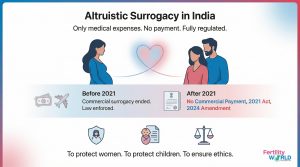
Before we talk about OCI-specific rules, let’s make sure you understand the basics, because everything else in your surrogacy journey depends on this.
Altruistic surrogacy means a woman carries and delivers a baby for the intended parents without getting paid. She doesn’t get paid for her service. The intended parents only pay for her medical bills, health insurance, and pregnancy-related requirements. That’s it. There is no “fee” for surrogacy. No deal. There is no business deal. This is the only legal way to be a surrogate in India right now.
How India Went from Surrogacy Capital to Strict Regulation
But it wasn’t always like this.
India was known as the “surrogacy capital of the world” for almost 20 years. Many international couples flew in, paid surrogate moms between ₹3 and ₹10 lakhs, and then took their babies home. It became a huge business, and behind the growth were actual women, many of whom came from poor backgrounds, whose bodies were being used as commercial vessels. There were a lot of reports of abuse, health risks without aftercare, emotional trauma, and children being left behind by the law.
Why Did India Ban Commercial Surrogacy?
The government stepped in. The Surrogacy (Regulation) Act, 2021 made it illegal to pay someone to be a surrogate and only allowed altruistic surrogacy with strict supervision. The 2024 Amendment Rules were the next big change. They said that intended parents can now use donor gametes (egg or sperm) as long as at least one parent is genetically related to the child. This was a big change because the old Act said that both gametes had to come from the intended parents, which left out a lot of infertile couples.
So, why did India change? Three reasons: to protect surrogate mothers from being taken advantage of, to preserve the child’s health and legal identity, and to make the procedure more ethical and accountable, as it had become dangerously unregulated.
Can OCI Holders Legally Do Surrogacy in India in 2026?
Let’s answer the question that led you here in a clear and direct way.
Yes. You can lawfully do altruistic surrogacy in India in 2026 if you have a valid OCI card. There is nothing illegal about it and no loopholes are being exploited. The Surrogacy (Regulation) Act, 2021 makes it clear that OCI cardholders are included in its scope. For surrogacy reasons, they are treated the same as Indian nationals. But before we go on, let’s make sure everyone knows what OCI means, because here is where a lot of couples get confused.
What Does OCI Status Mean for Surrogacy?
An Overseas Citizen of India (OCI) is not a citizen of India. It is a type of immigration status that allows people of Indian descent from other countries to live in India without a visa for life and to have certain rights to housing and work. You have a passport from another country. You reside in another country. But since you are Indian, you have this special legal access, which now includes the right to seek surrogacy in India.
So who exactly qualifies under the 2021 Act?
Only three groups of people can use surrogacy:
- Indian residents living in India,
- NRIs with valid Indian passports,
- and OCI cardholders
That’s all. If you are not Indian and do not have an OCI card, you cannot be a surrogate in India. There are no exceptions.
PIO Card Holders and the Old 2015 Circular – What Changed?
One crucial thing to remember is that if you still have an old PIO (Person of Indian Origin) card, it won’t function. In 2015, the Indian government combined PIO and OCI. Before you may file for surrogacy, you need to change your PIO card to an OCI card. Don’t skip this step.
If you’ve read that surrogacy is banned for OCI holders, that’s old news. Here’s why:
Important Legal Note: The 2015 MHA Circular (No. 25022/74/2011) said that those with OCI cards could not hire a surrogate in India. This circular caused a lot of misunderstanding and was used by clinics and lawyers for years. The Surrogacy (Regulation) Act, 2021 and its rules that came after it have taken its place. These provisions now clearly state that OCI holders can seek altruistic surrogacy under certain situations. The 2015 circular no longer holds legal authority on this matter.
We say this because even now, certain clinics and old blogs still talk about the old circular and refuse to see OCI couples. Don’t allow that happen to you. The law is on your side, but only if you meet the requirements, which we’ll talk about next.
Eligibility Criteria for OCI Holders to Pursue Surrogacy in India
Now that you know the law is on your side, the next question is: Are you eligible? This is when a lot of OCI couples run into their first problem. The requirements for eligibility are tight, clear, and cannot be changed. If you don’t meet all of the requirements, your application will be turned down. So read this part attentively and honestly think about where you are before you spend time and money.
Eligibility for the Intended OCI Couple
| Criteria | Requirement |
|---|---|
| OCI Status | Must hold a valid OCI card (PIO holders must convert first). |
| Marital Status | Must be a legally married heterosexual couple. |
| Marriage Duration | Minimum 5 years of marriage at the time of application. |
| Wife’s Age | Between 23 and 50 years. |
| Husband’s Age | Between 26 and 55 years. |
| Medical Condition | Proven medical infertility – certified by a registered ART clinic or government hospital. |
| Existing Children | No surviving biological, adopted, or surrogate-born child. (Exception: child with life-threatening illness or permanent disability). |
| Genetic Link | At least one intended parent must have a genetic connection to the child. Double donor (both egg and sperm from donors) is not permitted. |
| Home Country Law | The intended parents’ home country must legally recognize surrogacy and guarantee citizenship to the surrogacy-born child. |
Eligibility for the Surrogate Mother
Finding a surrogate isn’t just about medical fitness – the law is very specific about who she must be:
- She has to be a close relative of the intended OCI couple. She can’t be a stranger, a friend, or a hired lady.
- She has to be an Indian woman who is married and has at least one biological child of her own.
- Her age must be between 25 and 35 years.
- She can only be a surrogate once in her life; this is not something she can do again and again.
- She must pass medical and psychological examinations done by the licensed ART clinic.
- She must give informed written consent, which means she fully understands the process, the risks, and the fact that she will lose her parental rights when the baby is born.
Requirements for the Surrogacy Arrangement Itself
In addition to the people involved, the arrangement itself must meet these characteristics that cannot be changed:
- Purely Altruistic – No payment to the surrogate other than medical bills and insurance coverage. If any financial exchange is done, the entire arrangement will be illegal.
- Registered Clinic only – The IVF and embryo transfer must take place at an ART clinic that is registered with the ICMR. No private deal, no unregistered facility.
- Notarized Agreement – Before any medical procedure can start, both parties must sign and notarize a legally binding surrogacy agreement.
- Board Approval – The State or District Surrogacy Board must check the whole arrangement and give it their permission. Without board clearance, there can be no surrogacy.

Step-by-Step Surrogacy Process for OCI Card Holders in India (2026)
Now that you’ve confirmed you’re eligible. The real journey starts now, and we won’t sugarcoat it. This process needs careful planning, patience, and accuracy. There are nine steps you need to follow before you may bring your baby home. Some are easy. Some may test your patience. You will get there if you follow this map in the right order.
Why the Order of These Steps Matters
Before we start, one important thing to remember is that the order matters. There is no skipping ahead in this process. Starting IVF requires a court order first, and taking your child out of India is impossible without FRRO exit clearance. Every step opens up the next one. Take this like a legal relay race, using one baton at a time.
Phase 1A: Eligibility Verification and Embassy Letter (Steps 1–2)
- Step 1: Verify Your Eligibility and Gather Documentation
First things first, stop and check. Take a look at the requirements above and honestly decide if you and your partner meet them. Then get your papers together as soon as you can. This can take weeks. You will need your valid OCI cards, foreign passports, marriage certificate (attested or apostilled, proving 5+ years of marriage), medical infertility report from a licensed clinic, and proof that you don’t have any surviving biological or adopted child. Start this before you get to India. Start in your home nation. - Step 2: Obtain Your Embassy or Foreign Ministry Letter
This is frequently the hardest and most frustrating part of the whole process, and it’s also the part that most couples underestimate. You need an official letter from your home nation’s embassy in India or your foreign ministry that makes it clear that (a) your country legally recognises surrogacy, and (b) the child born through surrogacy would be able to enter your country and become a citizen. What’s the problem? Surrogacy regulations in many nations are unclear or change over time, and embassies are often slow or don’t want to send these letters. Begin this process months in advance. If your country’s position is unclear, hire a surrogacy lawyer in both India and your home country right away.
Phase 1B: FRRO Permission and Board Certificates (Steps 3–4)
- Step 3: FRRO/FRO Permission
You must go to the Foreigners Regional Registration Office (FRRO) as soon as you arrive in India, before you visit any clinics or meet any doctors, and obtain specific permission to become a surrogate. This is required and can’t be changed. The good news is OCI holders don’t require a separate Medical Visa for this. Submit your embassy letter, proof of marriage, medical reports, OCI cards, and a signed promise that you will take care of the child. FRRO reviews the request and grants permission. You can only continue forward after this. - Step 4: Certificate of Essentiality and Certificate of Eligibility
The District or State Surrogacy Board, which is the government group in charge of all surrogacy arrangements in your region, should be visited because you need two certificates from them:
-
- Certificate of Essentiality: This shows that surrogacy is medically necessary for you. Your infertility reports and your doctor’s recommendation support this.
- Certificate of Eligibility: This shows that you meet all the legal requirements of the Surrogacy Act
You need both certificates. Clinic that is registered and licensed will not take your case without these certificates.
Phase 2: Legal Formalities and the Surrogacy Agreement (Steps 5–6)
- Step 5: Court Order / Parentage Order
Many OCI couples are surprised to learn that they require a court order before the embryo transfer, not after the child is born. To get a parentage order, you need to file a petition at the right Indian District Court. This order says that you and your partner are the legal parents of the child from the moment they are born. It protects your rights, makes the process of a birth certificate easier, and is essential for the exit clearance later. Don’t skip this. Do not delay this. - Step 6: Surrogacy Agreement
Now that you have your certificates and court order, it’s time to formalise the arrangement. You (the intended OCI couple) and the surrogate mother sign a legally binding, notarized surrogacy agreement. This agreement covers everything, including custody rights, medical expenses, insurance for the surrogate, the surrogate giving up her parental rights when the baby is born, and the duties of both parties. The Surrogacy Board must also approve this agreement. No deals made with a handshake. No verbal promises. Everything is written down and legally binding.
Phase 3: Medical Process and Bringing Your Baby Home (Steps 7–9)
- Step 7: IVF and Embryo Transfer
Now, and only now, does the medical process start. You can only get IVF and embryo transfer done at an ART clinic that is registered with the ICMR. No unregistered clinic. At least one intended parent must give their egg or sperm to prepare the gametes. According to the 2024 Amendment Rules, donor gametes (egg or sperm from a third party) are allowed as long as one parent is genetically related to the child. The embryo is created and then transferred to the womb of the surrogate. - Step 8: Pregnancy Monitoring and Delivery
The certified ART clinic is in charge of monitoring the surrogate during the pregnancy. This includes regular exams, tracking her health, and providing medical help. The surrogate gives birth to the baby at a medical facility that is registered. After the baby is born, the court order you obtained in Step 5 allows the birth certificate to list the intended parents instead of the surrogate. This is why that early court order matters so much. - Step 9: Exit Clearance for the Child
Your baby is born. But you’re not done yet. You need to go back to the FRRO and ask for permission to leave India with your baby before you depart. FRRO checks that your original permission for surrogacy was granted, that the surrogate’s medical and legal responsibilities have been met, and that you now have legal custody. They keep copies of your OCI cards, passports, and birth certificate. You take your paperwork to your home country’s embassy in India, apply for the child’s citizenship and passport, and then you all fly home together.

Documents Required for OCI Surrogacy in India
If the process above felt like a lot then the paperwork behind it is just as demanding. Your application will be put on hold if you miss even one document, one expired attestation, or one unsigned form. Couples have lost months because their marriage certificate wasn’t apostilled or an embassy letter wasn’t written correctly. So use this part as your main checklist. Get everything together early, have your lawyer check every document, and make sure you have several certified copies of everything.
Personal and Identity Documents
- Valid OCI card and foreign passport – both partners (ensure neither is expired or due for renewal during the process)
- Marriage certificate – attested or apostilled by the appropriate authority in your home country
- Proof of marriage duration – must clearly show minimum 5 years of marriage at the time of application
Medical Documents
- Medical infertility certificate – issued by a registered ART clinic or government hospital in India, confirming the medical necessity for surrogacy
- Psychological fitness assessment – both intended parents must undergo and clear this evaluation
- Surrogate’s medical fitness certificate – confirming she is physically and psychologically fit to carry the pregnancy
Legal & Government Documents
- Embassy or Foreign Ministry letter – officially confirming that your home country recognizes surrogacy and will grant citizenship to the child
- FRRO special permission letter – obtained upon arrival in India, before any medical process begins
- Certificate of Essentiality – issued by the District or State Surrogacy Board confirming medical necessity
- Certificate of Eligibility – issued by the Surrogacy Board confirming you meet all legal criteria
- District Court parentage order – legally recognizing you as the child’s parents from birth
- Notarized surrogacy agreement – signed by the intended couple and the surrogate, approved by the Surrogacy Board
- Surrogate’s identity proof and informed written consent form – confirming she understands and agrees to all terms, risks, and legal relinquishment
Post-Birth Documents
- Child’s birth certificate – issued with intended parents’ names (facilitated by the court order obtained earlier)
- FRRO exit clearance – permission for the newborn to leave India, granted after verification of all legal formalities
- Home country citizenship application and passport for the child – filed at your country’s embassy in India before departure

How Much Does Surrogacy Cost for OCI Holders in India? (2026 Estimate)
Let’s talk about money. Even though altruistic surrogacy implies you don’t have to pay the surrogate, the process isn’t cheap. It all adds up: medical procedures, legal files, government permits, insurance, clinic fees, travel, and lodging. The good news is? India is still a lot cheaper than surrogacy charges in the US, UK, or even Ukraine, and it also has world-class medical care.
Here’s a realistic breakdown of what OCI couples should expect to spend in 2026:
| Component | Estimated Cost (INR) | Key 2026 Requirements and Notes |
|---|---|---|
| IVF Treatment and Medications | ₹3,00,000 – ₹6,00,000 | Includes ovarian stimulation, egg retrieval, fertilization, and embryo transfer. Costs may increase if donor eggs or sperm are required. |
| Surrogate Care and Support | ₹3,00,000 – ₹5,00,000 | Altruistic surrogacy only. Covers medical care, nutrition, maternity clothing, and pregnancy-related support. Direct compensation to the surrogate is illegal under Indian law. |
| Mandatory Insurance for Surrogate | ₹1,00,000 – ₹2,00,000 | Law mandates 36 months (3 years) of comprehensive health insurance coverage for the surrogate mother. |
| Legal and Court Fees | ₹2,00,000 – ₹4,00,000 | Includes mandatory court orders for parentage, surrogacy agreements, board approvals, documentation, and OCI-related legal formalities. |
| Hospital and Delivery Charges | ₹1,50,000 – ₹3,00,000 | Depends on hospital choice and type of delivery (normal or cesarean section). |
| Logistics and Post-Birth Formalities | ₹2,00,000 – ₹4,00,000 | Covers FRRO processing, embassy documentation, newborn passport issuance, and exit visa procedures. |
| Total Estimated Range | ₹12,00,000 – ₹25,00,000 | Comprehensive estimate for a successful single-cycle surrogacy journey in India (2026 compliance). |
Note: These are approximate ranges based on 2025–2026 industry averages and may vary depending on the city, clinic, legal counsel, and individual medical requirements. Multiple IVF cycles, complications during pregnancy, or extended stays in India can push costs higher. Contact us for a personalized cost estimate.
Key Challenges OCI Couples Face and How to Overcome Them
We want to be honest with you. Just because you have legal permission doesn’t mean the journey will be smooth. At least one of these barriers happens to every OCI couple we’ve seen so far. The couples who succeed are the ones who see these challenges coming and plan accordingly and in very early not in halfway through.
Challenge 1 – Embassy Letter Complications
This is where most OCI couples get stuck first. A letter from your home country’s embassy in India stating that it recognises surrogacy and will grant citizenship to the child. What’s the problem? Some European countries and many other countries don’t have clear surrogacy legislation. Their embassies are slow to respond, hesitate, or give ambiguous answers that Indian officials don’t accept.
What to do: Begin this process three to six months before you plan to go to India. Hire a surrogacy lawyer in your own country who has worked with embassies before. If your country’s position is unclear, your lawyer may need to provide legal opinions or precedents to push the embassy toward issuing the letter.
Challenge 2 – Finding a Close Relative as Surrogate
The legislation says that your surrogate must be a “close relative.” This means no friends, willing strangers, or anyone found through an agency can qualify. A really close family member. This is one of the hardest conditions for OCI families that have lived abroad for a long time to meet. Your family members in India might not want to come, might not be able to because of health reasons, or might be outside the 25–35 age bracket.
What to do: Talk to your family about it openly and honestly early on, before you start any legal action. Realise that this is a very personal request. If you don’t have a close relative who is accessible or eligible, talk to a lawyer to find out how surrogacy boards in the state where you want to seek surrogacy are defining “close relative.” Different people have understood things in different ways.
Challenge 3 – Residency Requirements
Some legal interpretations and various surrogacy boards have said that the intending couple should have lived in India for a while – sometimes up to 12 months – before applying. Not all states enforce this the same way, but it has surprised OCI couples, especially those who were planning brief trips to India to start the process.
What to do: Two weeks will not be adequate. Talk to your lawyer about your timeline and make sure it’s right. In some cases, couples have carefully planned their visits, arriving early to complete legal work, going home for the waiting period, and then returning for the medical procedures. Your lawyer should know what’s going on right now in the state and district where you’re filing.
Challenge 4 – Child’s Citizenship & Passport
Your baby was born in India, but your baby is not an Indian citizen. Before you leave, the child needs to be a citizen of your native country and have a passport. Also, every country has its own rules for children born through surrogacy. If at least one parent is a US citizen and has a genetic link to the child, the US usually grants citizenship to the child. When you get back to the UK, you need to get a parental order. Canada and Australia each have their own set of rules. Some countries make this easy. Others make it take a long time.
What to do: Before you start the procedure in India, make sure you know exactly what your home nation needs for children born through surrogacy. Don’t wait until the baby is delivered. Hire an immigration lawyer in your native nation and a surrogacy lawyer in India. These two need to work together, not one after the other.
Challenge 5 – Timeline Management
This is not a quick process. And having the wrong ideas about when things will happen causes more stress than practically anything else. Getting the legal approvals – FRRO permission, surrogacy board certificates, and a court order – can take four to six months on their own. With the IVF cycle, pregnancy, delivery, and post-birth exit formalities, the whole process will take 12 to 18 months from the moment you start until you go home with your baby. And that’s if everything goes well the first time. If the first IVF cycle doesn’t work, add 2–3 months to each subsequent cycle.
What to do: From the start, work with your clinic and legal team to set a realistic timeline. Don’t book your return flights too soon. Don’t tell your family when the baby will arrive. Give yourself some space, both emotionally and logistically. Couples who plan for 18 months and complete in 14 are much happier than couples who plan for 10 months and have setbacks at month 6.
Start Your Surrogacy Journey with Expert Guidance
If you’ve read this far, you are serious, and that tells us something about the sort of parent you’re going to be. The road ahead won’t be easy, but you don’t have to face it alone. At FertilityWorld, we’ve helped hundreds of OCI couples deal with the legal, medical, and emotional issues that come up when they want to have a baby in India. Our team comprises fertility experts, surrogacy lawyers, and specialized case managers who will be with you from the first meeting until you travel home with your baby.
Your family is waiting for you. Let’s take the first step together.
- CallW:9311850412
- Email: info@fertilityworld.in

Medical and Legal Disclaimer
Please note that the information in this guide is only meant to teach and inform. It is not meant to be legal or medical advice. India’s surrogacy rules can be changed, and different states and districts have different ideas about what they mean. Each case has its own unique set of legal, medical, and emotional issues. You should definitely talk to a qualified surrogacy lawyer and a registered fertility specialist before making any choices. FertilityWorld does not promise any specific medical or legal effects. Any cost figures are just approximations; the real amount will depend on where you live, the clinic you go to, and your specific needs.