

The surrogacy success rate in India is 40% to 85%, greatly influenced by age and the number of attempts. 35+ years of experience, doctors at Fertilityworld ensure individualized parenthood. In statistical output, it relies on the surrogacy success rate by age. Women between 25 and 35 exhibit better results. Compared to the surrogacy success rate in 2025, it has further improved with the adoption of upgraded ART in 2026. In this article, complete legal ART Act data, city-wise clinic comparison, donor vs self eggs, and factors affecting success rates are specifically defined.
- Book an online appointment: Get a free fertility consultation.
- Call/WhatsApp: 9311850412 Email: info@fertilityworld.in

What is the surrogacy success rate in India right now?

Before initiating the parenthood journey, all intended parents must know “what the success rate of surrogacy is.” On average, the surrogacy success rate in India, or the surrogacy success percentage, is between 40% and 85%, depending mainly on age, attempts, and clinic quality under the ART Act 2021 mandatory reporting. In 2026, the National Registry data shows that the first attempts’ average success rate is 45-55%, improving to 65-75% by the third cycle. Age is the biggest determinant—under 35 sees a 55-85% rise, while over 42 drops to 25-50% with self eggs. ICMR defines the IVF surrogacy success rate as a clinical pregnancy at 12 weeks with a heartbeat, not just a positive test. The surrogacy pregnancy success rate exhibits stability as long as the medical procedure of gestational (surrogate) surrogacy success rate is achieved. Let’s take a look at the surrogacy success rate of 2026 in India:
How Surrogacy Success Rate Is Calculated Under Indian Law

Surrogacy success data in India are calculated depending on the type of surrogacy, age, fertility health of the individuals involved, quality of embryos, specialists’ experiences at the fertility clinic, and clinic standards (which are 40% and 85% at Fertilityworld). These. These are the most common determinants of surrogacy success statistics in India. Yes, of course, surrogacy outcomes in India are also related to the medical situations of both intended parents for self-cycle—quality of eggs/sperm, reproductive health, ovulation timing, anovulation, PCOS, irregular menstrual cycles, infertility causes, and surrogate health.
ICMR Guidelines for Success Rate Measurement
What is the success rate of surrogacy? As per the ICMR guidelines, the surrogacy success rate is measured only after a clinical pregnancy is confirmed by an ultrasound with an infant’s heartbeat result at 12 weeks, rather than a biochemical pregnancy (blood test only) confirmation. The formula used for measurements of surrogacy success statistics in India is (Clinical pregnancies ÷ Total embryo transfers) × 100. The ART Act Section 25 mandates clinics to report data annually to the National Registry—falsification attracts ₹5-10 lakh penalties under Section 48.
Clinical Pregnancy vs Live Birth Success Rates
When compared, at the Fertilityworld clinic, the clinical pregnancy rate runs 40-85%, while the live birth rate (take-home baby) drops to 35-75%, which can be influenced by miscarriages or recurrent pregnancy. As discussed, age is one common factor in the clinical pregnancy vs. surrogacy live birth rate in India. The 4-8% gap increases with age—under 35 shows a 2-5% gap, and over 40 shows a 10-15% gap. Therefore, live birth success rates determine whether the intended parent is taking their baby home or not. Always ask clinics for live birth rates, not pregnancy rates. Consider these important points about surrogacy success rates:
- Clinical pregnancy = heartbeat at 12 weeks
- Live birth = healthy baby delivered after 24 weeks
- The miscarriage rate increases 2-3% per year after age 35
- National average gap between pregnancy and birth: 5-7%
- Surrogacy take-home baby rate: 35-75%
National Average Success Rate India 2026
As per the national average surrogacy success rate in India, clinical pregnancy is 52-68%, and live birth across all ages is 48-65%. These success rates also depend upon the standards of the clinic (expertise, technology used, and compassionate care): premium metro clinics average 55-70%, budget clinics 45-65%, and government hospitals 42-55%. These averages include all factors—individual success varies significantly due to differences in medical responses and the nature of reproductive systems. Comparatively, the surrogacy success rate in India in 2026 is better than the surrogacy success rate in 2025.
The table below depicts the Success Rate Definitions
| Metric | Definition | Rate | What It Means |
| Biochemical Pregnancy | Positive blood test | 48-75% | Hormone detected only |
| Clinical Pregnancy | Heartbeat at 12 weeks | 42-70% | Confirmed pregnancy |
| Live Birth | Baby born alive | 45-85% | Take-home baby |
Surrogacy Success Rate by Age in India

Surrogacy success rates in India by age are one of the top searched keywords because age plays a vital role. In pan-India, specifically at the Fertilityworld Centre, the average is between 75% and 85% overall, largely influenced by the intended mother’s age and her egg quality, with the highest success seen in women under 35. Naturally, the surrogacy success rate by age varies, declining with aging, decreasing to 40-65% for ages between 35 and 42, and dropping to 20-35% for those over 45. Age is the common factor in both the self-egg surrogacy success rate and the donor cycle. Surrogacy Success Rates by Age (First Attempt)
- Under 30: 75%–85%
- 30 – 35: 55% – 65%
- 35 – 40: 45% – 55%
- 40 – 45: 30% – 40%
- Over 45: 20%–30%
How Age Determines Your Success Probability
Age is the single most critical factor affecting surrogacy success, accounting for 40-50% of outcome variation. Women under 35 are considered the most fertile, as they have the best quality eggs. However, as they grow beyond 35, egg quality gradually declines, and ovarian reserves diminish. Age 40-42 reduced, with chromosomal abnormality risk jumping to 30-40%. Over 42, success plummets to 20-30% with self eggs, making donor eggs medically recommended. Donor eggs bypass age limitations completely, maintaining better success regardless of the intended mother’s age. Therefore, age is considered one of the most vital factors affecting surrogacy success .
Very important points for your reality check:
- Age affects egg quality and chromosomal abnormality rates
- Under 35: lowest abnormality risk (10-15%)
- Age 40+: abnormality risk exceeds 35%
- Donor eggs eliminate the age factor
- Legal age requirements: wife 25-50, surrogate 25-35
Age-Based Success Rates with Self Eggs
In self-egg surrogacy, the success rate by age for women between 25 and 30 is 75-85%. Age 30-35 represents the largest group at 55-65% success, with excellent egg quality still. Ages 35-40 experience 45-55% success as egg reserve declines. Age 40-42 drops to 30-40% with doctors recommending PGT-A testing. Over 42 shows 20-30% success—donor eggs become a standard medical recommendation at this age, with 85-95% success improvement.
Donor Eggs Success Rate Remains Consistent
Donor egg surrogacy success rate maintains 75-85% across all intended mother ages, whether 32 or 42+. Success depends entirely on the young donor’s egg quality (typically 21-30 years), not the recipient’s age. Cost adds ₹1.2-1.8L but eliminates age-related gamete and hormonal health decline. Surrogacy success rate with donor eggs is the best option for those women with poor egg quality. As per the ICMR guidelines, recommended donors for age 40+ (intended mother) are those with AMH levels below 0.5 or after 2-3 self-egg failures:
- Donor eggs: 75-95% success despite of any age group (25-42+)
- Donor age (21-28) determines excellent success
- Cost: +₹1.2-1.8L upfront added to inclusive cost
- Recommended: age 42+, low Anti-Müllerian Hormone, repeated failures
- Legal and anonymous regulated under the ART Act 2021
Below Table: Age-Based Success Rates (First Attempt)
| Your Age | Self-Eggs Success | Donor Eggs Success | Recommended Path |
| Under 30 | 60-70% | 70-80% | Self eggs |
| 30-35 | 55-65% | 68-78% | Self-eggs |
| 35-40 | 45-55% | 65-75% | Self eggs + PGT testing |
| 40-42 | 30-40% | 60-70% | Donors after 1-2 fails |
| 42-45 | 20-30% | 55-60% | Donors recommended |
| Over 45 | 15-25% | 40-55% | Donors strongly advised |
Surrogacy Success Rate by Number of Attempts
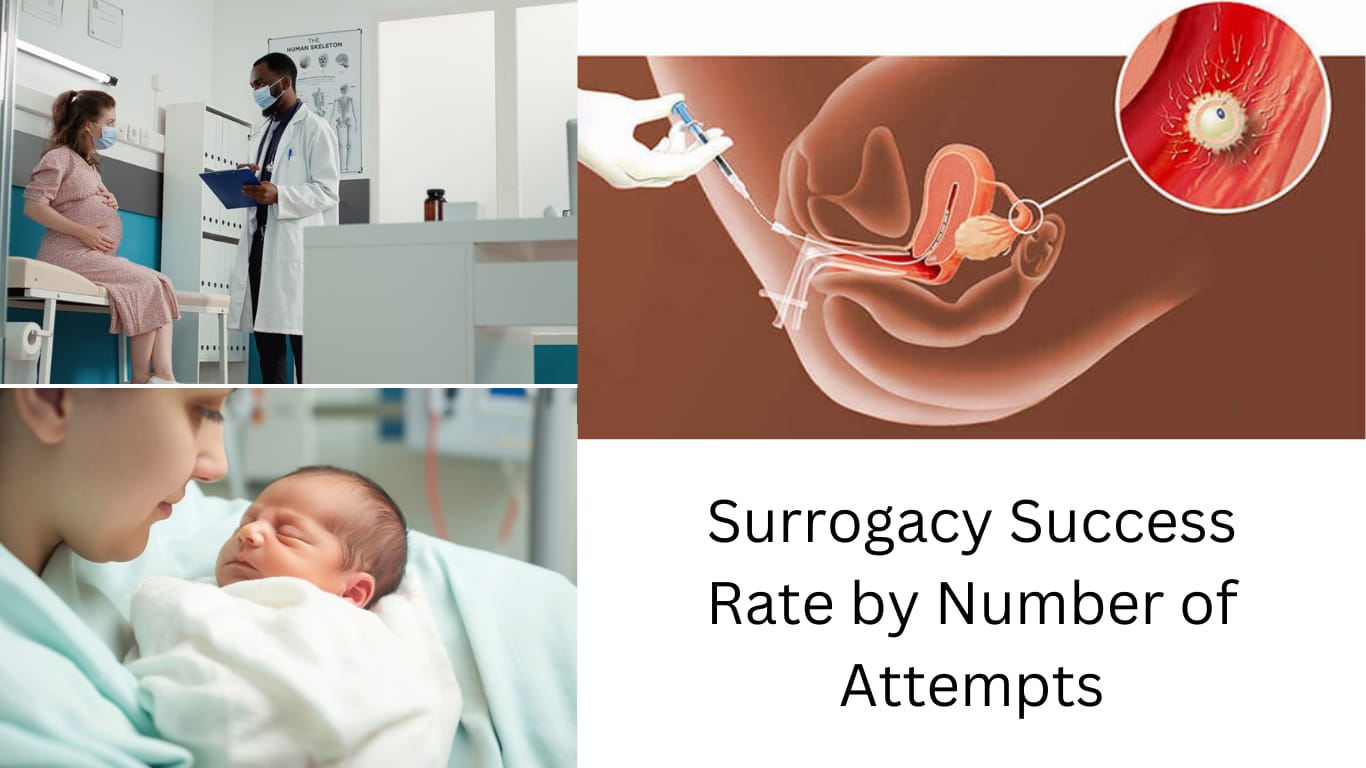
Some couples may not be fortunate enough to succeed in surrogacy parenthood on the first attempt and may require a repeat cycle. Even though intended parents have to pay a little more, the surrogacy success rate by attempts keeps improving. The recorded maximum attempt is 3 cycles, but the surrogacy second attempt success rate is the ultimate peak for parenthood. Let’s discuss further about surrogacy success after the first attempt below:
Why Multiple Attempts Are Usually Needed
The first surrogacy attempt succeeds in between 42% and 55% nationally, depending on the fertility conditions and type of surrogacy (self-cycle/donor cycle), meaning 20-40% of couples need a second try. This isn’t failure—it’s normal biological variability. Sometimes, even perfect embryos don’t guarantee implantation due to timing, uterine receptivity, immune factors, and unexplained variables. Surrogacy success after the first attempt increases up to 95%. Premium clinics like Fertilityworld achieve 75-85% on the first attempt under a friendly budget. Budgeting for 2-3 attempts is realistic planning, not pessimism. The surrogacy success rate in the first cycle depends upon the fertility conditions, the standards of the clinics, and the technology applied.
- First attempt national average: 42-55%
- Some intended parents need 2nd attempts for fertility uncertainty
- Biological variability, not medical failure
- Premium clinics (Fertilityworld): 75-85% first attempt
- Budget clinics for 2-3 cycles are recommended
💡 The table represents the success rate by Attempts (All Ages Combined)
| Attempt Number | Cumulative Success | Cost |
| First Attempt | 42-55% | ₹12-25 Lakhs |
| Second Attempt | 65-72% | ₹6-8 Lakhs |
| Third Attempt | 75-82% | ₹6-8 Lakhs |
| Fourth Attempt | 78-85% | ₹6-8 Lakhs |
Self Eggs vs Donor Eggs Success Rate Comparison in India

In the comparison of self-egg vs. donor-egg surrogacy success rates, using a donor egg assures confidence in disclosing better success rates before the medical procedure starts. However, the self-egg surrogacy success rate can be comparatively closer to using donor eggs if the intended parents have healthy gametes (egg/sperm) and are clinically recommended to women under 35 years. Donor eggs are usually best for women over 35 years old.
Self-Egg Success Rate Varies by Age
The self-egg surrogacy success rate output is typically favorable to women’s age: under 30 shows 60-70%; under 35 shows 55-65%; age 35-40 drops to 45-55%; age 40-42 falls to 30-40%; and over 42 plummets to 20-30%. Chromosomal abnormalities increase with age. No donor fees (saves ₹1.2-1.8L), but lower success may require up to 3 attempts to achieve parenthood. Surrogacy success rate by age is the most discussed factor in ART parenthood.
Donor Eggs Maintain 75-85% Success All Ages
The donor egg surrogacy success rate shows a consistent average of 75-85% regardless of the intended mother’s age. The highest surrogacy success rate in India is obtained using donor eggs. Success depends on the young donor’s egg quality (21-30 years typically). The first attempt shows 60-70%, and the cumulative is 80-95% by the third. Add ₹1.2-1.8L in cost, but better success means fewer attempts.
- Donor eggs first attempt: 60-70%
- Your age doesn’t matter (donor’s age matters)
- Cumulative by third attempt: 80-95%
- Donor Cost: +₹1.2-1.8L upfront
- Better than self-eggs after age 42, seek donor eggs.
When to Choose Donor Eggs Medically
35+ years of experience: The best surrogacy doctors in India, at FertilityWorld, recommend intended parents to use donor eggs if they’re beyond 42+ years of age or any intending woman with lower AMH below 0.5, multiple self-egg cycle failures (2-3 attempts), poor embryo quality repeatedly, or genetic disorder risks. Success improves from 20-40% (self) to a donor egg surrogacy success rate of 65-85% (donor) at age 42+. Women’s age is the most important surrogacy success factor, followed by the class of technology applied and the reputation of the providing centre. FertilityWorld offers premium services at the lowest price in India.
💡 The table below indicates – Self vs Donor Eggs Success
| Your Age | Self-Eggs | Donor Eggs | Eggs Improvement | Cost Difference |
| Under 30 | 60-70% | 70-80% | +10-15% | +₹1.2-1.8L |
| 30-35 | 55-65% | 68-78% | +10-20% | +₹1.2-1.8L |
| 35-40 | 45-55% | 65-75% | +20%-30% | +₹1.2-1.8L |
| 40-42 | 30-40% | 60-70% | +30-35% | +₹1.2-1.8L |
| Over 42 | 20-30% | 55-60% | +40-50% | +₹1.2-1.8L |
Fresh vs Frozen Embryo Transfer Success Rates in India

When it comes to surrogacy, the choice between fresh and frozen embryo transfer depends on various factors, including the surrogate’s health, embryo quality, and intended parents’ preferences. The fresh embryo surrogacy success rate ranges from 45% to 85% per transfer, with higher rates in women under 35. Whereas the frozen embryo surrogacy success rate may be slightly lower, between 35% and 75% per transfer. Overall, the surrogacy embryo transfer success rate is above 60%. Below is a comparison of success rates between fresh and frozen embryo transfers:
Fresh Embryo Transfer Success Rate: 42-85%
The fresh embryo transfer is done 3-5 days after retrieval- Immediate transfer after successful fertilization (egg+sperm=embryo). This fresh embryo surrogacy success rate shows 42-85% with variation by age of the egg. The IVF surrogacy success rate is higher in women under 35 years. Fresh embryo transfers do not experience freezing stress, as the transfer is immediate. However, it has less time for testing, and synchronization is harder. This method is recommended when embryo quality is excellent, and PGT is not needed.
Frozen Embryo Transfer Success Rate: 35-75%
The frozen embryo surrogacy success rates show 35% to 75% per transfer, often 5-10% lower than fresh transfer. It creates enough time for PGT-A testing, better timing, and optimal uterine preparation. Vitrification has 95%+ survival rates. Surrogacy success rate with PGT testing is common in parents with genetic risk. Now preferred at premium clinics like the FertilityWorld.
- Frozen FET: 35-75% success
- Fresh transfer: 45-85% success
- Frozen allows PGT-A testing
- Better uterine preparation timing
- Vitrification survival: 95%+
- Becoming standard in India
Key Factors Affecting Surrogacy Success Rate in India

Surrogacy success rates rely upon various factors, including the age and health of the individuals involved, embryo quality, and the expertise of the fertility clinic. Other surrogacy success factors include types of surrogacy, donors (egg/sperm), and complete surrogacy process execution. These factors affecting the surrogacy success rate are necessities that have a large impact on the surrogacy success chances. Let’s discuss more components that influence the surrogacy success rate in India
Intended Mother Age and Egg Quality Impact
Age accounts for 40-50% of success variation; the younger the mother, the higher the success rate. AMH levels indicate egg reserve quantity and quality: >2 is excellent, between 1 and 2 is good, 0.5-1 is low, and <0.5 AMH level donors are needed. Follicle-stimulating hormone (FSH) day 3: <10 good, 10-15 borderline, >15 poor prognosis.
For self-cycles, the intended mother’s age is the vital factor affecting the surrogacy success rate. Age variation also directly impacts the AMH and FSH levels, contributing to poor egg quality.
Surrogate Mother Health and Age Impact
The Surrogacy Act restricts surrogate age to 25-35. A young, healthy surrogate improves success by 20-35%. Her Body Mass Index (BMI) is ideally at 18-28, with no smoking/alcohol and no chronic conditions, with a previous successful pregnancy required, which ensures surrogacy pregnancy success. A surrogate’s age doesn’t affect egg quality (not her genetics), but affects carrying ability.
- Surrogate age: 25-35 (legal requirement)
- BMI: 18-28 optimal
- A previous successful pregnancy is mandatory
- No smoking/alcohol/drugs
- Improves success: 20-35%
Embryo Quality and PGT-A Testing Impact
In surrogacy, embryos are categorized using grading systems that estimate the success rate of surrogacy embryo transfer.
Embryo grading:
- Grade AA/AB gives 60-85% success.
- Grade BB gives a 45-75% success rate.
- Grade BC/CB gives a 30-65% success rate.
- Grade CC gives a 20-55% success rate.
PGT-A testing improves surrogacy success rate by 8-15% for age 35+. It costs up to ₹80K-1.5L. The surrogacy success rate with PGT testing of blastocysts (day 5-6) has a 10-15% higher success rate than day 3.
Clinic Technology and Doctor Experience
Premium clinics and laboratories with time-lapse incubators show 8-12% better results. Fertilityworld clinic doctor’s experience of 500+ cases handled versus 50 cases shows significant variation. Embryologist skill is critical—poor handling reduces success by 15-20%. The ART Act mandates success disclosure. The FertilityWorld surrogacy clinic’s success rate in India is between 45% and 85%. Advanced clinic technology and specialists’ experience affect the best surrogacy success rate in India.
- Time-lapse incubators: +8-12% success
- Doctor experience matters significantly
- Embryologist skill critical
- Lab quality affects outcomes
- Check clinic registration, certification, and successful history.
Number of Embryos Transferred Impact
The surrogacy embryo transfer success rate depends on the number(s) of embryos transferred into the surrogate uterus and the probabilities of twins and triplet babies.
- Single embryo transfer (SET): 42-85% success, zero twins.
- Double embryo transfer (DET): 55-65% success, 20-30% twin risk.
- ICMR recommends SET for under 35, DET for 38+, or after failures.
💡 The table below shows the success rate impacted by Factor
| Factor | Optimal Success | Poor Success | Impact |
| Mother’s Age | Under 35: 55-65% | Over 42: 20-30% | Very High |
| AMH Level | >2 ng/mL 58-68%, | <0.5 20 to 28% | Very High |
| Embryo Quality | Grade AA/AB: 60-85% | Grade CC: 20-55% | Very High |
| PGT-A Testing | Normal embryo: 60-70% | Untested 45-55% | Moderate |
City-Wise Surrogacy Success Rate Comparison in India

Depending on the city standards, advanced technology available, and experienced doctors, there are differences when compared with the surrogacy clinic success rate in India. Below, the Fertilityworld doctors with 35+ years of experience have shared the surrogacy success rate in metro cities in India, and the surrogacy success rate in India by clinic.
Delhi NCR Success Rates: 75-85%
Delhi NCR has been a surrogacy hub for many years due to its advancement in medical tourism. But every clinic obtains different results. The surrogacy success rate in Delhi, India, like the Fertilityworld premium clinics, is 55-85%; mid-tier clinic 52-60%; budget clinic 45-52%. The best surrogacy success rate in India is driven by experienced doctors and advanced technology. The Delhi Medical Council regulates reporting under the ART Act. In Delhi NCR, consider the best surrogacy centres in India.
Mumbai Success Rates: 58-75%
Mumbai reports India’s second-highest success rate—with premium services resulting in 65-75%, mid-tier clinics resulting in 58-65%, and budget clinics giving 48-55%. Celebrity doctors, international labs, and stringent patient selection are comprehensive services offered.
- Premium clinics: 65-75%
- Mid-tier: 58-65%
- Budget: 48-55%
- Highest in India
- Selective patient screening
Bangalore Success Rates: 58-70%
The average surrogacy success rate in Bangalore, India, is 58-70%. The IT hub attracts younger, healthier couples for the surrogacy program in Bangalore. Advanced labs, experienced teams, and reputed clinics like FertilityWorld have the highest records of fulfilled parenthood. The Karnataka ART Authority ensures the surrogacy program is reported as legal and safe. An English-speaking environment improves communication between the patients and the staff.
The Fertilityworld surrogacy clinic’s success rate in India (Bangalore) is assured.
Chennai and Hyderabad Success Rates: 50-65%
In Chennai, the surrogacy success rate is 52-65%, and the surrogacy success rate in Hyderabad, India, is 50-63%. However, these cities attract many patients for their affordable costs and diverse demographics—wider age ranges slightly reduce averages. Clinical quality is comparable to metros. State authorities mandate annual reporting.
💡 The table below indicates – City-Wise Surrogacy Success Rates
| City | Premium | Mid-Tier | Budget | Average |
| Mumbai | 65-75% | 58-65% | 48-55% | 62-75% |
| Delhi NCR | 75-85% | 52-60% | 45-52% | 58-70% |
| Bangalore | 58-70% | 55-63% | 45-52% | 56-65% |
| Chennai | 55-65% | 50-58% | 42-50% | 52-60% |
| Hyderabad | 55-63% | 48-58% | 40-48% | 50-58% |
Top Clinics’ Success Rate in India Comparison Guide

Fertilityworld is the best surrogacy agency in India, which records the best surrogacy success rate in India among all the surrogacy success rate clinic comparisons. It has been serving surrogacy for more than 35 years and expanded throughout India, rendering its premium services at a most reasonable price.
How to Compare Clinic Success Rates Correctly
The ART Act Section 13 mandates age-stratified success rates, rather than overall averages. Ask for success by your age group, live birth not pregnancy rate, self eggs vs. donors separately, and first attempt vs. cumulative cycles. Verify the National Registry registration of the clinic. The highest surrogacy clinic success rate in India is between 75% to 85%. When a surrogacy success rate clinic comparison is conducted between clinics, we mainly consider the following factors:
- Ask for age-specific data
- Live birth rate (not pregnancy)
- Self vs donor eggs separate
- First vs cumulative attempts
- Verify ART Registry registration
Red Flags in Clinic Success Claims
You will find many surrogacy clinics in India that disclose transparent and flexible success rates on their websites or during a free consultation, like the fertilityworld, and many clinics advertise higher success rates just to attract the patient. On average, the surrogacy clinic’s success rate in India for women under 35 years is 45% to 75%. When the surrogacy success rate comparison in India is surveyed, the highest is recorded at the FertilityWorld Clinic in pan-India. Some of the red flags or warning signs include the clinic claiming a high success rate without age stratification, refusing age-specific data, reporting pregnancy (not live birth), excluding failed cycles, cherry-picking young patients, making unrealistic promises, and not being registered with the National Registry.
Essential Questions to Ask Clinics
Critical questions to ask the clinics during free consultations:
- What’s the birth rate for my age?
- How many cycles last a year?
- What is the first attempt vs. the cumulative success rate?
- Does the clinic offer PGT-A/ERA?
- Any record of handled failed cycles—discount?
- National Registry verification proof?
- Surrogacy-specific success rate in the clinic?
Surrogacy vs Regular IVF Success Rate in India

Surrogacy vs. IVF success rates in India vary based on several factors.
Gestational surrogacy tends to have higher success rates compared to regular IVF, especially for women with uterine issues or repeated IVF failures. This is because surrogates have already carried a healthy pregnancy and undergone thorough medical screening. IVF success rates, on the other hand, depend on various factors, including age, embryo quality, clinic expertise, service standards, and fertility conditions.
Why Surrogacy Success Is Higher Than IVF
Between surrogacy and IVF success rates in India, surrogacy obtains up to 95% (higher), whereas the regular IVF surrogacy success rate is up to 85% (lower) because the surrogate’s young and healthy uterus (age 25-35 legal) outperforms the older intended mother’s womb. Primarily, the surrogates have proven fertility and excellent uterine health. Surrogacy bypasses uterine factors causing IVF failures. Let’s have a quick understanding of the given points below:
- Surrogacy: up to 95% success rate
- Regular IVF: up to 85% success rate
- Surrogate young uterus advantage, boost surrogacy
- Proven fertility required—proven surrogate
- Bypasses uterine issues in the intended mother.
When Surrogacy Equals IVF Success
Here are some scenarios where surrogacy can equal IVF success: If the intended mother is under 35 with a perfect uterus, only the male fertility factor is dealt with—IVF 50-60% matches surrogacy 55-65%. Surrogacy advantages emerge with uterine factors, age-related issues, and recurrent miscarriages. For 40+ with good eggs but a poor uterus, surrogacy improves success by 20-30%.
Legal Requirements for Success Rate Reporting in India

The fertilityworld, disclosing the success rate, strictly follows art act success reporting. In the earlier records of the surrogacy success rate in India, in 2025 was up to 65%, but today, surrogacy success data in India is 85% due to upgraded advanced technology. Rules and regulations of surrogacy vary from countries. India is one of the surrogacy legal countries in Asia, but India has its own specific Act. Let’s see further about the legal requirements for success rate reporting in India. In India, the Surrogacy (Regulation) Act of 2021 and the Assisted Reproductive Technology (Regulation) Act of 2021 govern surrogacy practices. While there isn’t a direct mention of success rate reporting requirements, clinics are mandated to follow strict guidelines to ensure transparency and safety.
ART Act 2021 Mandatory Success Disclosure
The ART Act Section 13 mandates clinics display surrogacy success statistics in India, update annually, and submit to the National Registry. Data must be age-stratified, procedure-specific, and show pregnancy and live birth rates. Non-compliance with the act can cost about ₹5-10 lakh in penalties and license suspension. Clinics must publish verifiable success rates, typically audited by a third party. However, patients are advised to ask for success rates broken down by age, diagnosis, and treatment type to avoid misleading statistics.
ICMR Guidelines for Success Calculation
The ICMR guidelines for standardized success calculations state to disclose clinical pregnancy at 12 weeks (heartbeat), and live birth rate of a minimum of 24 weeks. Biochemical success rate can be excluded, but all transfers must be included. It recommends that clinics ensure uniform reporting and enable accurate comparison of surrogacy success statistics in India. Any violations are reported tothe State Medical Councils.
- Clinical pregnancy = 12-week heartbeat
- Live birth = 24+ weeks gestation
- All transfers counted (no cherry-picking)
- Standardized reporting nationwide
- Medical Council enforcement
National Registry Verification Process
To ensure surrogacy clinic success rate india, the National Registry collects clinic data annually, cross-verifies clinics’ records, and conducts audits. Clinics report cycles, including pregnancy rate, births, and complications by age. The Individual clinic comparison is not yet public but expected in 2026-2027. The National Surrogacy Board (NSB) and State Surrogacy Boards (SSBs) oversee the implementation of the Surrogacy (Regulation) Act, 2021, and monitor compliance.
How to Improve Your Surrogacy Success Rate in India

To improve surrogacy success rates in India, and surrogacy success chances, the following factors affecting surrogacy success rate or surrogacy success factors discussed below must be strictly followed by all involved parties.
Pre-Treatment Optimization Steps
To ensure accuracy in surrogacy success chances, the quality of the egg is tested before 3-6 months, and recommended medications (CoQ10, DHEA, antioxidants). Not only does the egg quality, but it also achieves a BMI of 18-25, which is good for surrogacy success. The intended parents or egg donors must quit smoking/alcohol if using, you must manage diabetes/thyroid issues, follow the supplement Vitamin D as per specialists, and reduce stress by doing regular yoga/meditation. These Pre-treatment optimization steps improve factors affecting surrogacy success rates by 10-20%.
A quick Points to ponder:
- CoQ10 600mg daily boost egg quality
- Achieve optimal BMI 18-25 (best for surrogacy requirements)- intended mother or donor.
- Quit smoking 3+ months before if using
- Consume Vitamin D 2000 IU daily as per prescriptions
- Yoga/meditation is the best method for de-stressing
- Following these steps improves success by 10-20%
- Contact the fertilityworld for the best surrogacy navigation.
Choosing the right clinic in India Improves Success
The right clinic you choose makes a big difference in the success rate improvement- Consider seeking the fertilityworld guide. Always go for the clinic which has handled 500+ surrogacy cases, 75%+ success in your age group, PGT-A/ERA availability, time-lapse embryology, National Registry registration, and transparent reporting. Remember that clinic quality services and standards account for a 10-20% success variation. The best surrogacy success rate in India is recorded by the FertilityWorld Clinic between 75%-85%. This surrogacy clinic’s success rate in India contributes to an overall percentage.
Consider PGT-A and ERA Testing
Surrogacy success rate with PGT (₹80K-1.5L) testing improves success by 8-15% for 35+ age women, as the procedure picks normal embryos from among abnormal embryos and implants the selected embryos. ERA (₹40-60K) testing is recommended if the parents have failed surrogacy success after multiple attempts, 2 cycle failures identify the optimal window. ERA improves the 10-15% success rate. Combined changes in surrogacy success from 30-40% can be improved to 50-75%.
When to Switch to Donor Eggs
Switching to donor eggs can be a viable option for individuals or couples facing fertility challenges, including 2 failed cycles if the woman’s partner is 40+ of age, 3 failures if the woman is 38-40 years old. Donor option is also recommended in women with AMH level <0.5 (any age), and poor embryo quality repeatedly. The donor egg surrogacy success rate is 75-85%. If you’re aware of factors affecting surrogacy success rate, consider using a donor. Earlier decision saves money—because 2 failed self-egg cycles can cost (₹12-25L), but a single donor cycle embraces parenthood at ₹13-20L. Look at the main important points when to switchfrom self-cycle to donor eggs:
- Women age 40+: after 2 failures
- Women age 38-40: after 3 failures
- AMH level below 0.5: consider immediately
- Poor embryo quality records: switch sooner
- I Want to save money and enjoy parenthood.
Frequently Asked Questions About Success Rates
Understanding Your Personal Surrogacy Success Rate

Your personal surrogacy success rate depends on various factors. National average success rate 40-65% means nothing for YOUR situation, as it depends upon individual age, egg quality, performing clinic, testing, and surrogate health, which creates personal probability. What could be your success rate of surrogacy? If you’re under 35 years and have a good AMH level at premium, expect 65-85% success in the first attempt. If you’re 44 years old with a low AMH level, expect 20-35% success; use of donors is the best option. Surrogacy success chances, understand YOUR factors, optimize controllable elements, and make informed donor decisions. Success within 1-3 attempts is realistic for most.
- Consult a Fertilityworld specialist: Discuss your medical history and lifestyle, and get a personalized assessment.
- Know Your Medical Conditions: Review your medical records, including previous pregnancies, fertility treatments, and health conditions.
- Consider Genetic Testing: Genetic testing can help identify potential issues that may impact success rates.
Final CTA:
📞 Get Personalized Success Rate Assessment for Your Situation Based on Age, Medical History & Clinic Comparison Free Consultation: Contact the fertilityworld.