

You get down with a fertility expert, and in just a few minutes, three words come up: IUI, IVF, and ICSI. They sound quite the same. But they aren’t. And all of a sudden, one of the most crucial choices you’ve ever had to make seems impossible. You are not the only one. Every year, thousands of couples who are confused between IVF and IUI f go through this identical moment, unsure, distraught, and yearning for someone to just explain what each procedure means for them.
We at Fertility World think that every couple should get clear, honest advice when they are looking into their initial fertility treatment alternatives. We want to help you choose between IUI vs IVF vs ICSI based on your own scenario. Finding the best fertility option for couples trying to get pregnant shouldn’t be a guessing game. This guide clearly and simply explains all of the options for assisted reproductive technology, so you may feel informed and confident when you go to your next appointment.
- Book an online appointment: Get a free fertility consultation.
- CallW:9311850412
- Email: info@fertilityworld.in
What Are IUI, IVF, and ICSI? A Simple Breakdown
Let’s first talk about what each fertility treatment really is in straightforward, everyday language before we compare them to see which one is best for you. No definitions from books. Just simple, easy-to-understand explanations.
What Is IUI (Intrauterine Insemination)?
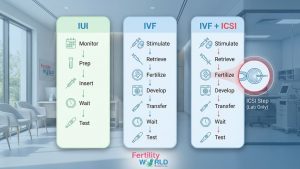
Are you thinking what the full form of IUI is? IUI full form in medical is Intrauterine insemination. IUI treatment is only a way to give nature a little push. The sperm is collected, cleansed to find the healthiest swimmers, and then put straight into the uterus at the moment of ovulation. No surgery. No getting eggs. The sperm still has to travel a long way to get to the egg, but it’s a lot shorter than before.
The IUI procedure works best for couples with mild male factor infertility, unexplained infertility, or those using donor sperm, such as single women and same-sex couples. It is also an affordable fertility treatment option and the best place to start for anyone who is just starting their journey to having a baby. If you’re thinking, “Can IUI work for low sperm count?” Yes, for mild situations. It is really the best treatment for unexplained infertility to try initially before going on to more complicated procedures.
What Is IVF (In Vitro Fertilisation)?
IVF treatment takes the procedure out of the body and gives it to the science of an embryology lab. Hormones make your ovaries work harder so they can make more eggs. Under light sedation, the eggs are taken out, fertilised with sperm in the lab, and then the embryo is delicately put back into your uterus. IVF is recommended over IUI since it gets around natural problems your body may be having, like blocked fallopian tubes, problems with ovulation, or bad cervical mucus. For women with disorders like PCOS, endometriosis, or infertility that comes with becoming older, it is the most common female infertility treatment. IVF also offers something IUI cannot: IVF also lets you preserve embryos for later use and test their genes with PGT-A, which gives you greater control over your family planning journey.
What Is ICSI (Intracytoplasmic Sperm Injection)?
This is the most common misunderstanding: ICSI and IVF are not two different treatments. This is a method utilised in IVF, and knowing the difference between IVF and ICSI changes everything. ICSI full form is intracytoplasmic sperm injection. What’s the ICSI meaning? In a normal IVF procedure, sperm are put in a lab dish next to an egg, and fertilisation happens on its own. With ICSI treatment, an embryologist picks out one healthy sperm and injects it straight into the egg. This means that the sperm doesn’t have to get through the egg on its own.
Who needs ICSI treatment? If the sperm count is very low, the motility is very poor, or if the sperm needs to be surgically removed by procedures like TESA or PESA, this is the best option. This male infertility treatment is also utilised when a prior IVF cycle had poor
fertilisation results. And the question that everyone wants to know is, “Is ICSI painful?” Not at all. From your point of view as a patient, IVF and IVF+ICSI are the same. You won’t feel anything during the ICSI stage, which takes place totally in the lab.
IUI vs IVF vs ICSI: At a Glance Comparison
| Feature | IUI | IVF | IVF + ICSI |
|---|---|---|---|
| Invasiveness | Low | Moderate-High | Moderate-High |
| Procedure Location | Clinic | Operating Theatre | Operating Theatre + Lab |
| Egg Retrieval Required | Not Required | Required | Required |
| Lab Fertilisation | Not Involved | Yes | Yes – Single sperm injection |
| Best For | Mild infertility, donor sperm | Blocked tubes, PCOS, endometriosis | Male factor, poor fertilisation history |
| Typical Duration | 1-2 weeks | 3-5 weeks | 3-5 weeks |
| Embryo Freezing Option | Not Available | Available | Available |
| Genetic Testing (PGT-A) | Not Available | Available | Available |
| Patient Experience | Clinic visit, no sedation | Sedation required | Same as IVF – difference is in the lab |
IUI vs IVF vs ICSI – Key Differences You Need to Know
Now that you know what each treatment does, let’s speak about the distinctions that matter to you: your body, your schedule, and your budget. Knowing the genuine difference between IVF and IUI, as well as the difference between IUI vs IVF vs ICSI, can help you make a confident choice.
Invasiveness and Procedure Complexity – What Your Body Goes Through
If you’re worried about how it feels physically, here’s the truth, from least to most involved.
- IUI is the best option for your body. No surgery, no anaesthesia, and no sedation. The IUI treatment is like a regular gynaecological exam in that it just takes a few minutes and is only slightly painful. It is also the fastest fertility treatment, with the whole cycle taking only 1–2 weeks.
- IVF takes more time and effort. Hormone injections over 10 to 14 days are part of the IVF process to get your ovaries to work better. After that, the eggs are taken out while you are lightly sedated, and then the embryos are put back in. There is a time of healing, and your body will feel the process.
- IVF and ICSI? The good news is that ICSI is not more painful than IVF. From your point of view as a patient, they are both the same. The ICSI process takes place only in the embryology lab, not in your body. No extra shots, no extra sedation, and no extra pain. So, is ICSI safer than IVF? Yes, because it doesn’t bring any more physical stress.
Cost Comparison Of IUI, IVF, and ICSI
Let’s be honest: cost is one of the first things couples think about, and that is completely understandable. Most couples start with IUI since it is the most affordable fertility treatment option per cycle. Hormone medicines, monitoring scans, theatre fees, and lab work all add up to a lot more money for the IVF treatment. And sure, ICSI costs more than regular IVF since it needs a very skilled embryologist to do the single-sperm injection method in the lab.
But when you do the IUI vs IVF cost com
parison, keep in mind that the cost per cycle is only one part of the puzzle. The cumulative cost of IUI vs IVF starts to appear quite similar after three unsuccessful IUI cycles. Sometimes, getting to IVF sooner is not only better for your health, but it can also save you money in the long run.
The cost difference between IUI, IVF, and ICSI is not the same for everyone. It varies depending on your clinic, city, diagnosis, and protocol. The table below is a good place to start.
IUI vs IVF vs ICSI: Cost Comparison
| Treatment | Base Cost Per Cycle (INR) | Medication Cost (Approx.) | Typical Cycles Needed | Estimated Total Investment |
|---|---|---|---|---|
| IUI | ₹10,000 – ₹20,000 | ₹3,000 – ₹8,000 | 2–3 cycles | ₹30,000 – ₹80,000 |
| IVF (Standard) | ₹1,50,000 – ₹2,50,000 | ₹40,000 – ₹80,000 | 1–2 cycles | ₹1,90,000 – ₹3,30,000 |
| IVF + ICSI | ₹1,80,000 – ₹3,00,000 | ₹40,000 – ₹80,000 | 1–2 cycles | ₹2,20,000 – ₹3,80,000 |
| IVF + ICSI + PGT-A | ₹2,50,000 – ₹4,00,000 | ₹40,000 – ₹80,000 | Usually 1 cycle | ₹2,90,000 – ₹4,80,000 |
Success Rates – What the Numbers Actually Mean for You
Before you look at any percentage, know that success rates are based on the experiences of thousands of people, not on what will happen to you. The quality of your embryo, your age, your diagnosis, and the clinic you go to all affect your prognosis. Numbers are a guide, but they don’t promise anything.
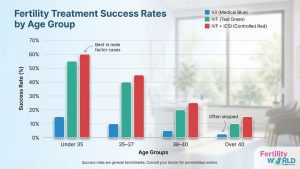
This is what the success rate comparison of IUI vs IVF vs ICSI really shows us:
- IUI has the lowest per-cycle success rate, but it works well over 2-3 attempts for the right candidate and remains the most affordable fertility treatment starting point
- IVF has a better success rate than IUI per cycle, especially for women under 35, where results are significantly stronger
- ICSI vs IVF success rate is broadly comparable overall, but ICSI delivers a clear, clinically proven advantage specifically in male infertility cases, particularly severe oligospermia and azoospermia, where standard IVF would likely fail
Age is the only thing that all three treatments have in common: it is the best predictor of outcome. More than the procedure chosen, more than the money spent. And speaking of cost, a higher price tag does not automatically mean a higher chance of pregnancy. Before making a decision, always ask your specialist what realistic, individualised expectations they have.
Success Rate Comparison by Age Group
| Age Group | IUI (Per Cycle) | IVF – Standard (Per Cycle) | IVF + ICSI – Male Factor Cases |
|---|---|---|---|
| Under 35 | 15–20% | 45–60% | 50–65% |
| 35–37 | 10–15% | 35–45% | 40–55% |
| 38–40 | 8–12% | 25–35% | 30–40% |
| Over 40 | 5–8% | 15–25% | 20–30% |
How to Know Which Treatment Is Right for You
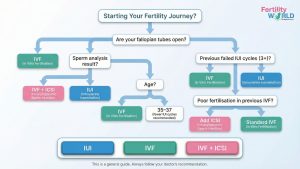
When choosing a fertility therapy, you shouldn’t just go with what worked for someone else. It’s not a trend, a guess, or a choice that works for everyone. Your diagnosis, age, history, and priorities will all determine the right fertility treatment for you. This part should be your own guide.
Choose IUI If…
Is this you?
- Your sperm count is mildly low but not severely compromised
- Your fallopian tubes are open and healthy
- Ovulation is regular, or can be triggered with medication
- You have been diagnosed with unexplained infertility, and no major structural issues have been found
- You are looking for the most affordable fertility treatment option to begin with
- You are a first-time fertility patient who wants to start gently before escalating
If you are the proper person, IUI is the best first therapy. It’s not settling; it’s sensible. Most experts say that you should try 2–3 IUI cycles before moving to IVF. This gives your body the best chance with the least amount of help.
But be honest with yourself: if your diagnosis clearly points elsewhere, IUI may not be the most efficient route. Before you assume that IUI is the best place to start, talk to an expert.
Choose IVF If…
Does any of this sound familiar?
- You have already tried 3 or more IUI cycles without success
- Your fallopian tubes are blocked or damaged
- You are 38 or older and time is a real factor in your journey
- You have PCOS or endometriosis that is moderate to severe
- You want the option to freeze embryos for future use
- You want access to genetic testing (PGT-A) before transfer
Couples whose biology needs more help don’t have to give up on IVF; it’s just a more direct way to get pregnant. Yes, the emotional and financial step up is real, and it is okay to feel that weight. But IVF gives you significantly higher success rates per cycle and far more control over the process. If you are wondering, what is the best fertility treatment after a failed IUI? For most couples, the answer is IVF.
Choose ICSI (With IVF) If…
This is the most important question: Is the male component the biggest problem in your trip to get pregnant?
- When should ICSI be added to your IVF cycle?
- Sperm count is severely low (oligospermia)
- Sperm motility or morphology is critically poor
- Because of azoospermia, sperm must be surgically removed using TESA or PESA.
- You need to safeguard yourself against having another IVF round that doesn’t work or has bad fertilisation.
- When the quality of your sperm is on the edge, your doctor suggests it as a way to stop it from happening.
It’s important to remember that picking ICSI doesn’t mean picking a different treatment. This means your IVF cycle includes an extra embryology phase in the lab. Your experience as a patient doesn’t change. Is ICSI a better option than IVF for men who can’t become pregnant? Yes, without a doubt, when the quality of the sperm is quite bad. It is the best way to treat severe low sperm count.
Which Treatment to Choose Based on Your Diagnosis
| Diagnosis / Situation | Recommended First Treatment | Notes |
|---|---|---|
| Mild low sperm count, open tubes | IUI (2–3 cycles) | Try IUI first before escalating |
| Unexplained infertility (under 35) | IUI = IVF if no response | Most start with 2-3 IUI cycles |
| Unexplained infertility (over 35) | IVF directly | Time is a factor – skip IUI |
| Blocked fallopian tubes | IVF | IUI cannot bypass blocked tubes |
| PCOS – mild, ovulating | IUI with ovulation induction | Monitor for hyperstimulation risk |
| PCOS – failed IUI or severe | IVF (freeze-all protocol) | Freeze-all reduces hyperstimulation risk |
| Endometriosis (mild) | IUI possible | Discuss with specialist |
| Endometriosis (moderate–severe) | IVF | Better outcomes with direct IVF |
| Severe male factor infertility | IVF + ICSI | ICSI significantly improves fertilisation |
| Azoospermia (surgical retrieval) | IVF + ICSI (TESA/PESA) | ICSI essential with retrieved sperm |
| Failed fertilisation in previous IVF | Add ICSI to next IVF cycle | Protects against repeat failure |
| Advanced maternal age (38+) | IVF or IVF + ICSI | Skip IUI – time is critical |
| Single woman / donor sperm | IUI or IVF (age-dependent) | IUI first if under 38, tubes open |
| Same-sex female couple | IUI or IVF (age-dependent) | Same criteria as donor sperm cases |
Which Fertility Treatment Fits Your Situation? Common Scenarios Explained
Not every question about fertility can be easily put into a diagnosis box. You know how you type a question into Google at midnight and then wait for someone to answer it? Here are the most prevalent real-life scenarios, along with honest answers.
IVF vs IUI for Endometriosis – What Should You Know?
If you have mild endometriosis, you can still get IUI, but the picture changes as the condition gets worse.
If you have mild endometriosis, you can still get IUI, but the success rates are lower than for people who don’t have endometriosis. Talk to your doctor about it. If you have moderate to severe endometriosis, IVF is the best choice. IVF allows doctors much more control over fertilisation and implantation when endometriosis has impacted the tubes, the quality of the eggs, or the environment in the uterus. It can also be used with surgery to treat lesions for better results.
IUI vs IVF for PCOS – Which Works Better?
In short, always know what stage of endometriosis you have before you decide on a treatment. A lot of people are surprised to learn that having PCOS doesn’t always imply you require IVF. A lot of women with PCOS get pregnant using IUI and ovulation induction medicine, especially when:
- They are youthful and have fallopian tubes that are open.
- Their partner has normal sperm counts.
- PCOS is the only known cause of infertility.
But PCOS also raises the risk of ovarian hyperstimulation during IVF, thus it’s very important to choose the right procedure. If IUI hasn’t worked for a woman or if she has other fertility problems, the safest and most successful next step is usually IVF with a freeze-all embryo method.
What Is the Best Fertility Treatment for Low Sperm Count?
The honest answer is that it depends on how low it is.
This is how it breaks down:
- Mildly low count, good motility = IUI with sperm washing concentrates the best swimmers and often works well.
- Moderate to severe low count = IVF + ICSI is the medically appropriate choice, the single sperm injection bypasses the need for natural penetration entirely.
- Azoospermia (no sperm in ejaculate) = Surgical retrieval via TESA or PESA combined with ICSI is the only viable route.
One essential thing to remember is that you should never try to figure out how serious your problem is from an online semen report. What really dictates your protocol is what an andrologist says about your clinical situation.
Final Thoughts – You Don’t Have to Figure This Out Alone
It’s not merely a medical choice to choose between IUI vs IVF vs ICSI. It’s an emotional one. A monetary one. And for a lot of couples, this is one of the most intimate choices they will ever make together.
There is no one best fertility treatment for everyone. The best one for you depends on your body, your diagnosis, and your goals. What works for someone else may not work for you. That’s OK. What matters most is that you don’t have to put things together by yourself late at night using search results and forums. We at Fertility World want to help you find the best fertility option for your journey. We do this by giving you honest advice, not putting you under any pressure, and making a plan that works for you, not a generalisation.
Ready to get clarity? Get in touch with a fertility counsellor today to find out what to do next.
- CallW:9311850412
- Email: info@fertilityworld.in
Which treatment is best for male infertility: IUI, IVF, or ICSI?
IUI may be suggested for minor sperm problems. ICSI is often the best choice for low sperm count, poor motility, aberrant morphology, or previous fertilization failure because it directly injects a single sperm into the egg.
When should you choose IUI instead of IVF?
When the fallopian tubes are open, the sperm count is normal or slightly lower, and the woman is under 35, IUI is usually the best option. It is less intrusive and cheaper than IVF, but it also has a lower success rate with each cycle.
When is IVF better than IUI?
If the fallopian tubes are obstructed, the guy has moderate to severe infertility, the woman has endometriosis, or unexplained infertility after failed IUI cycles, or if the woman is over 35 and doesn't have much time, IVF is usually the best option.
When is ICSI necessary?
ICSI is required when sperm quality is markedly diminished, when sperm must be surgically extracted, or when prior IVF cycles demonstrated inadequate fertilization. It is also often utilized when a man has severe infertility.
What are the success rates of IUI vs IVF vs ICSI?
Depending on age and illness, the success rate of IUI ranges from 10% to 20% per cycle. For women under 35, the success rate of IVF is usually 40–60% per cycle. It goes down as women get older. ICSI works about as well as IVF because it is a form of IVF technique.
How many IUI cycles should you try before moving to IVF?
If the woman is under 35, most fertility experts say she should try 3–4 IUI cycles before thinking about IVF. IVF may be a better option if you have tried several times and haven't had any luck.
Is ICSI more expensive than IVF?
ICSI costs a little more than regular IVF since it needs more advanced lab techniques and knowledge of embryology. But it could stop fertilization failure in situations of male infertility, which would save money in the long term.
Which treatment is less painful: IUI or IVF?
IUI is less intrusive and usually doesn't hurt much. IVF is harder on the body than IUI because it requires injections, egg retrieval while the patient is sedated, and embryo transfer.
Can you switch from IUI to IVF or ICSI if it fails?
Yes, many couples start with IUI and move to IVF or ICSI if pregnancy does not occur. Treatment plans are often adjusted based on response, age, and underlying fertility factors.